It's been a while since I posted. Here's why.
The Very Short Version
I had some mysterious medical issues, at first very scary, now largely resolved, which for several weeks meant that if I looked at my computer, I felt sick. After extensive medical testing, everyone's best guess seems to be atypical migraines brought on by anemia.
The Long Version
On Thursday, April 29th, just before bedtime, after I'd been at my computer for several hours straight, I started experiencing a visual anomaly: basically, I had a big splotch in my field of vision that looked like the kind of bright semi-blindness you get after a camera flash. I had it in both eyes. It freaked me out, but it went away after five or ten minutes. When I got in bed and tried to read a book, I couldn't. I could read each individual word, but when I tried to string them together to make some kind of sense, I couldn't. Which really freaked me out. I felt perfectly fine otherwise, and I thought maybe I'd just given myself such a scare with the vision thing that I had, I don't know, made myself temporarily unable to concentrate. Or something. I put the book aside and went to sleep, figuring I'd deal with it in the morning if whatever it was was still happening. And it wasn't: in the morning, I was fine, and I chalked it up to eye strain and freaking myself out, and went about my business.
Nine days later, Saturday, May 8th, it happened again. This time it was around 9:00 PM, and I'd been playing a computer game for about an hour, and I got another camera-flash blob. I left the computer and went into the living room and turned on the TV. Again, the blob went away within five or ten minutes, and what followed was some kind of disorientation. I was watching Lost (on the TiVo), and though I could understand everything that happened, I couldn't follow the thread of the plot from scene to scene, and nothing seemed to have context.
I thought I was having a stroke.
We hauled the kid out of bed and went to the ER, for the second time in a month. They took my blood and pronounced me extremely anemic (from the blood loss from the miscarriage) as well as dehydrated. They did a CT Scan which showed nothing. They said it was probably atypical migraine or atypical seizure, and I should see my doctor as soon as possible.
The next few days are kind of a blur. I felt like hell, in retrospect partly because I kept looking at my computer, which it took me some time to realize was provoking a lot of the rotten feeling, but also because I was terrified. My doctor wanted me to get an MRI to rule out some very scary shit including brain cancer, and it was a couple of days before those results came back totally clear. I didn't have any more visual anomalies or periods of disorientation. What I had was a lot of nausea, dizziness, and general feeling like hammered crap. I also had a full work-up by a neurologist, including an EEG to rule out seizures, the results of which I'm still waiting for: I have the follow-up appointment this week.
Once I figured out that the computer, particularly reading anything on the computer, made me feel terrible, I turned it off and stopped looking at it entirely. Books and magazines were the same, but less intense: I could read non-electronic text for a a few minutes before it started making me feel weird, and my ability to read non-e text without adverse effect returned within a week or so. Oddly, I could read my iPhone comfortably.
By Friday, six days after the episode that sent me to the ER, I was feeling considerably more like myself. Feeling normal again made me realize just how wrong I'd been feeling all along. That wasn't the end of the episodes, but it was the end of feeling shitty all the time. From that point on, I felt mostly normal and fine, with isolated incidents of not-OK.
I went back to my GP, and she said that based on all the data she had by that point, her best guess was that I was having clusters of migraines, the first few "with aura" (that's what the camera-flash blob was), and that it probably had everything to do with my extreme anemia (which I have been beating back with massive doses of iron since my first GP visit after the ER) and the stresses on my body caused by the miscarriage and hemorrhage, and that she doubted it meant I'd become a migraineur. The neuro said basically the same thing, but wanted to rule out seizures, which I'll find out about later this week.
It's common, apparently, for women (most migraineurs are women) to begin getting migraines during some big hormonal change: pregnancy, menarche, menopause, etc. And the migraines often stop at some other hormonal event. Some women have them during pregnancy and never have them again. Many female migraineurs tend to have them at particular points in their menstrual cycle. Anyway, it makes some kind of sense that the the anemia along with the hormonal upheaval of my system resetting after the miscarriage would have provoked either a one-time cluster of migraines or the beginning of some migraine phase of my life. Of course, I'm very much hoping it's the former, but I can live with the latter. Better nauseous and disorienting migraines than the kind with blinding pain, after all (presuming, if I continue to get them, they will be like the ones I've already had) or any of the far-more-terrifying possibilities ruled out by the MRI.
Did you know they have TV in MRIs now? I couldn't actually see the Today Show because I had to take my glasses off, but the sound was pleasantly distracting. So was the Valium. The neurological evaluation was nifty, too. It was all a bunch of follow-my-finger, walk-in-a-line-heel-to-toe, tell-me-where-I'm-sticking-you-(gently)-with-this-pin type stuff, all of which made me want to grill the dude about neurology. I'd have even warmer and fuzzier feelings about all of it if all the tests and hospital visits and the fact that Andy's employer hosed us this year on medical insurance didn't mean that we had to cancel our modest September beach vacation.
Anyway. I had my last arguably migrainey spell on the 23rd after having a short night's sleep and being a bit hungover. And really, for the past few weeks, it's been tough to tell what's migrainey from what's just a bit queasy and wifty. I started back at the computer five or ten minutes at a time last week with no adverse effects, and now I'm spending upwards of an hour here (hello!) without even having little panic attacks about it. My guess about why the computer and to a lesser extent other reading provoked the spells is something to do with eye strain and maybe needing bifocals (I've been myopic since I was 8). So I'm hitting the opthalmalogist this week, too.
I talked to my pal the midwife at my OB's office a couple of weeks ago, and she said she didn't think it was a good idea to start trying to conceive until the anemia was gone. She said "a couple of months," but I can't see it taking that long. My hemoglobin had gone from around 8 to over 10 the first week after the ER visit, when I was taking three iron pills a day. That's already nearly normal, and I've been taking two a day since, so I'll be very surprised if my blood test next week doesn't show perfectly respectable levels. I've already had a normal (I suppose) period, which means I'm (probably) ovulating again, so now that I feel normal and am no longer freaked out about this whole thing, I'd just as soon get back on the horse ASAP. Especially since this entirely-without-fun roller coaster ride started when I got pregnant in February and it is now June, and I am in no way getting younger.
I'm off to the OB for a follow-up ultrasound and sit-down with one of the full-metal OBs this afternoon, so I'm going to talk to him about it. And I'll see my GP next week after getting the EEG results and also the results of a blood draw, so I'll be talking to her about it, too. And then I'd really like not to see the inside of another medical establishment until I'm safely and successfully and without incident knocked up. Cross your fingers!
Tuesday, June 1, 2010


Friday, April 23, 2010
Miscarriage, Act III: There Will be Blood
Tuesday evening, three weeks to the day after the disappointing ultrasound, the miscarriage began in earnest. And when I say "earnest," try to picture that scene in The Shining with the elevator doors. In retrospect, now that I'm home from the hospital, I know that what was happening was not just surprisingly heavy flow, but a hemorrhage.
I called my OB's office and got juggled by incompetents at their answering service for a while, finally got a call back from the on-call doctor, who wasn't a member of the practice. He prescribed Methergine, a hormone, to slow the bleeding. Andy went and got it, and I took the first dose at 9:30 PM.
It was a scary night, and one of the worst things was having to make the judgment call myself. The standard is soaking through a pad an hour; more than that, and you're supposed to go the ER. But that's an extra-tough call to make when going to the ER involves waking your sleeping toddler and hauling him off with you. After the Methergine kicked in, the bleeding slowed, but I was still soaking more than a pad an hour, and I was passing some pretty horrifying clots. Tissue (normal) or clots (if large, worrisome)? How was I supposed to know? The trend was positive -- I was definitely bleeding less. So I stuck it out, and after the second dose of the hormone, around 2:00 AM, the bleeding slowed significantly, and I was able to sleep until 6:30.
In the morning, everything seemed fine. Bleeding like a normal period. I called the OB's office, and they said I should come in and get checked, which I did at 11:30. Andy took the day off work. I saw the midwife, she did a pelvic exam, and everything looked normal. In her opinion, I'd just had an all-at-once miscarriage, and though she could still see some blood and clots, she expected that I wouldn't bleed heavily again, and probably not for long. So, good! Hurray for that. Such relief.
We got home around 1:00, and the heavy bleeding started again. I called the office, and by the time the midwife called me back, I was beginning to feel light-headed. I should have mentioned it, but it didn't seem significant, especially since I'd hardly eaten all day, and I'm prone to feeling light-headed when underfed. She told me to take the Methergine again, but if I was still soaking a pad an hour after four hours to go to the ER. I took the Methergine at 2:30 and went upstairs to try to nap. I slept some, but mostly I just lay in bed and bled and worried. When I got up at around 5:00, I had to sit down at the bottom of the stairs because I felt like I was about to black out.
So we went to the ER.
The admitting doctor was a putz. He asked me how long my OB would "let me" continue bleeding. I told him what the midwife had said about four hours post-Methergine, and he started arguing with me in way I didn't entirely understand. I explained that I expected -- and I assumed my OB practice expected -- that going to the ER meant I would get a D&C at the hospital. The doctor said no, the ER would refer me back to the OB. That seemed crazy, but I wasn't about to argue with him, since I figured either another doctor would be less stupid or someone would call my OB.
They wheeled me into the inner section of the ER, and Ben became blessedly absorbed by Cars and Trucks and Things That Go. Eventually another doctor came in, who began by asking me how I knew I was pregnant, which flummoxed me completely. Uh, because I know how to pee on a stick? So he got the whole history and concluded that I needed an ultrasound before they could determine any course of treatment, which seemed entirely sensible to me. By the time they wheeled me out for the ultrasound, the bleeding had mostly stopped. That was around 7:30.
Another doctor joined in the fun. He said based on the ultrasound, which showed a small amount of tissue remaining, and the fact that the bleeding had stopped, we had two options: send me home with the caveat that if heavy bleeding started again, I was to come right back, and if not, go to the OB in the morning; or transfer me to Bellevue (the sister hospital a couple of miles away that handles all the OB/Gyn stuff for the hospital system) where they could keep a closer eye on me and possibly give me the D&C as soon as that night. They wanted to take my vital signs again and consult with someone from my OB practice before making the call. The vitals were what clinched it: they took them lying down, sitting up, and standing, and my heart rate was somewhere in the realm of crazy-cuckoo when I stood up, so no going home for me. Which was fine. The last thing in the world I wanted was to go home and start bleeding and have to haul the poor toddler out of bed and start this whole nonsense over again, but at some charming hour like 2:00 AM.
So Ben and Andy went home. And let me take a moment here to sing the praises of my mellow and largely unflappable toddler, who sat quite happily in a chair looking at books and crashing toy cars together and watching Seinfeld and eating crackers and charming nurses until nearly three hours after his bedtime. And Andy, for whom patience and calm do not come easily, who smoothly distracted Ben out of every possible turn into crabbiness and held my hand and didn't freak out even a little. At around 9:30, they went home, and I waited for the ambulance.
The next few hours were kind of hard. From the time we got to the ER, I felt enormously relieved that, whatever happened from that point, at least I wouldn't be the one making judgment calls, and if the crazy bleeding kept up or started up again, someone would know what to do. But when Andy left, I felt alone, and sad to be alone. I have lovely friends here who I'm sure would have jumped in the car if I'd called, but it didn't seem a dire enough emergency, my desire for further company and hand-holding, to get other mothers of babies and toddlers out of their beds at 10:30. I'd have called my mom if she weren't three hours away. I'd have called older friends with whom I have deeper credit, if they lived nearby. Maybe. It's hard to ask for help, even when you want it.
When the EMTs wheeled me into my room at Bellevue, I could hear a newborn crying. The room was just down the hall from where I'd stayed when Ben was born. I've never felt, throughout the loss of this pregnancy, that I was mourning a lost baby -- but ending this journey in that place was hard. The doctor on call couldn't come talk to me because he was delivering babies. I asked, when I woke up the following morning, how many babies they'd delivered that night. The nurse said five, and I'm not even sure why I asked, because of course it made me cry.
No one knew whether I'd be getting a D&C that night, or in the morning, or not at all. Which was fine, but it meant that I wasn't allowed to eat or drink, which sucked. I was substantially dehydrated from all the blood loss, and I'd been getting IV fluids since arriving at the ER, but it didn't make me less thirsty. They let me have a sip of water to take the Ambien which it was someone's excellent idea to give me around midnight, and handing that cup back demanded the kind of willpower I don't generally admit I'm capable of. I wasn't hungry until morning, and then I had to start changing channels when food ads came on.
In the morning, I had another ultrasound and another blood draw. The doctor (this time someone from my own OB practice) came in around 11:00, 12 hours since I'd been admitted and the first time I'd spoken to an actual MD, and said if I hadn't already lost so much blood, he'd be tempted to send me home to let the rest of the tissue pass normally, but he didn't want to run the risk that I'd start bleeding again, so he wanted to give me a D&C. Which, duh. I mean, I think I'd have burst into tears if he'd tried to send me home again.
They put me under for the surgery, bless them. Not on-a-ventilator under, just knocked out and with a local. So the surgery, so far as I'm concerned, was a total breeze. I came to, dozed for a while in recovery, then got wheeled back to my room. Most of my focus was on when could I eat something and might there be crackers and I have crackers in my bag if there aren't crackers here and can I eat crackers yet? The nurse brought me saltines and ginger ale, and never have such things tasted so good.
Andy and Ben had come for a visit in the morning between breakfast (theirs, of course) and nap time, and I'd requested -- for my sake and Ben's, not so much Andy's -- that they not come back until I was about ready to be released, since I preferred to rest and watch something on TV other than Dora or Dinosaur Train. After I gorged myself on crackers and further demonstrated my ability to function extra-hospitally by peeing, the nurse said it was just a matter of some paperwork (translation: maybe two hours) before I'd be free to go. That was around 3:30. I called Andy, and he and Ben came back. I was home by 5:00.
The bleeding started Tuesday night. I spent Tuesday night bleeding and freaking out, Wednesday night in two hospitals, and Thursday night sleeping soundly in my own bed. Today is Friday.
In terms of the surgery itself, I feel absolutely fine. I had some very mild cramping last night, wholly solved with ibuprofen. No pain whatsoever today. But I'm still feeling weak from the blood loss. The doctor told me to take iron supplements, and I should have thought to buy some on the way home, but I didn't, and I don't think I should drive, so Andy's going to stop by the pharmacy on his way home from work. Not feeling 100% up to kid-wrangling this morning with Andy back at work, I called in the cavalry, and two marvelous friends turned up to take Ben to the playground and wear him out.
No sex for four weeks. No attempting to conceive until after my next period, which will probably be in four to seven weeks. If I'd had the D&C three weeks ago, of course, I'd be three weeks ahead of this schedule. I think it's the timing I find most frustrating. We would have started trying to get pregnant this past fall, but I needed several dental procedures that were best done before conceiving, and what with scheduling and waiting for pre-approval from insurance, that ran us into January. I got pregnant in February, the first cycle trying, but it turned into a bit of a catastrophe, and now we can't even start trying again until the end of May at the latest, and probably more like the middle of June. I'm 37. The clock is ticking.
In the short term, right now, I'm feeling kind of traumatized. My bathrooms freak me out. Having always enjoyed rude good health, having my only experience of pregnancy before this an entirely by-the-book gestation and delivery, I'm finding myself pretty shaken, especially given my age, by the idea of the next pregnancy and all the things that can go wrong. A miscarriage, even one that goes as badly as this one, is really the least of my worries. It's like, once the possibility of this bad outcome was made manifest, the floodgates opened, and now all the bad outcomes seem far more plausible, far more threatening, far more real.
I called my OB's office and got juggled by incompetents at their answering service for a while, finally got a call back from the on-call doctor, who wasn't a member of the practice. He prescribed Methergine, a hormone, to slow the bleeding. Andy went and got it, and I took the first dose at 9:30 PM.
It was a scary night, and one of the worst things was having to make the judgment call myself. The standard is soaking through a pad an hour; more than that, and you're supposed to go the ER. But that's an extra-tough call to make when going to the ER involves waking your sleeping toddler and hauling him off with you. After the Methergine kicked in, the bleeding slowed, but I was still soaking more than a pad an hour, and I was passing some pretty horrifying clots. Tissue (normal) or clots (if large, worrisome)? How was I supposed to know? The trend was positive -- I was definitely bleeding less. So I stuck it out, and after the second dose of the hormone, around 2:00 AM, the bleeding slowed significantly, and I was able to sleep until 6:30.
In the morning, everything seemed fine. Bleeding like a normal period. I called the OB's office, and they said I should come in and get checked, which I did at 11:30. Andy took the day off work. I saw the midwife, she did a pelvic exam, and everything looked normal. In her opinion, I'd just had an all-at-once miscarriage, and though she could still see some blood and clots, she expected that I wouldn't bleed heavily again, and probably not for long. So, good! Hurray for that. Such relief.
We got home around 1:00, and the heavy bleeding started again. I called the office, and by the time the midwife called me back, I was beginning to feel light-headed. I should have mentioned it, but it didn't seem significant, especially since I'd hardly eaten all day, and I'm prone to feeling light-headed when underfed. She told me to take the Methergine again, but if I was still soaking a pad an hour after four hours to go to the ER. I took the Methergine at 2:30 and went upstairs to try to nap. I slept some, but mostly I just lay in bed and bled and worried. When I got up at around 5:00, I had to sit down at the bottom of the stairs because I felt like I was about to black out.
So we went to the ER.
The admitting doctor was a putz. He asked me how long my OB would "let me" continue bleeding. I told him what the midwife had said about four hours post-Methergine, and he started arguing with me in way I didn't entirely understand. I explained that I expected -- and I assumed my OB practice expected -- that going to the ER meant I would get a D&C at the hospital. The doctor said no, the ER would refer me back to the OB. That seemed crazy, but I wasn't about to argue with him, since I figured either another doctor would be less stupid or someone would call my OB.
They wheeled me into the inner section of the ER, and Ben became blessedly absorbed by Cars and Trucks and Things That Go. Eventually another doctor came in, who began by asking me how I knew I was pregnant, which flummoxed me completely. Uh, because I know how to pee on a stick? So he got the whole history and concluded that I needed an ultrasound before they could determine any course of treatment, which seemed entirely sensible to me. By the time they wheeled me out for the ultrasound, the bleeding had mostly stopped. That was around 7:30.
Another doctor joined in the fun. He said based on the ultrasound, which showed a small amount of tissue remaining, and the fact that the bleeding had stopped, we had two options: send me home with the caveat that if heavy bleeding started again, I was to come right back, and if not, go to the OB in the morning; or transfer me to Bellevue (the sister hospital a couple of miles away that handles all the OB/Gyn stuff for the hospital system) where they could keep a closer eye on me and possibly give me the D&C as soon as that night. They wanted to take my vital signs again and consult with someone from my OB practice before making the call. The vitals were what clinched it: they took them lying down, sitting up, and standing, and my heart rate was somewhere in the realm of crazy-cuckoo when I stood up, so no going home for me. Which was fine. The last thing in the world I wanted was to go home and start bleeding and have to haul the poor toddler out of bed and start this whole nonsense over again, but at some charming hour like 2:00 AM.
So Ben and Andy went home. And let me take a moment here to sing the praises of my mellow and largely unflappable toddler, who sat quite happily in a chair looking at books and crashing toy cars together and watching Seinfeld and eating crackers and charming nurses until nearly three hours after his bedtime. And Andy, for whom patience and calm do not come easily, who smoothly distracted Ben out of every possible turn into crabbiness and held my hand and didn't freak out even a little. At around 9:30, they went home, and I waited for the ambulance.
The next few hours were kind of hard. From the time we got to the ER, I felt enormously relieved that, whatever happened from that point, at least I wouldn't be the one making judgment calls, and if the crazy bleeding kept up or started up again, someone would know what to do. But when Andy left, I felt alone, and sad to be alone. I have lovely friends here who I'm sure would have jumped in the car if I'd called, but it didn't seem a dire enough emergency, my desire for further company and hand-holding, to get other mothers of babies and toddlers out of their beds at 10:30. I'd have called my mom if she weren't three hours away. I'd have called older friends with whom I have deeper credit, if they lived nearby. Maybe. It's hard to ask for help, even when you want it.
When the EMTs wheeled me into my room at Bellevue, I could hear a newborn crying. The room was just down the hall from where I'd stayed when Ben was born. I've never felt, throughout the loss of this pregnancy, that I was mourning a lost baby -- but ending this journey in that place was hard. The doctor on call couldn't come talk to me because he was delivering babies. I asked, when I woke up the following morning, how many babies they'd delivered that night. The nurse said five, and I'm not even sure why I asked, because of course it made me cry.
No one knew whether I'd be getting a D&C that night, or in the morning, or not at all. Which was fine, but it meant that I wasn't allowed to eat or drink, which sucked. I was substantially dehydrated from all the blood loss, and I'd been getting IV fluids since arriving at the ER, but it didn't make me less thirsty. They let me have a sip of water to take the Ambien which it was someone's excellent idea to give me around midnight, and handing that cup back demanded the kind of willpower I don't generally admit I'm capable of. I wasn't hungry until morning, and then I had to start changing channels when food ads came on.
In the morning, I had another ultrasound and another blood draw. The doctor (this time someone from my own OB practice) came in around 11:00, 12 hours since I'd been admitted and the first time I'd spoken to an actual MD, and said if I hadn't already lost so much blood, he'd be tempted to send me home to let the rest of the tissue pass normally, but he didn't want to run the risk that I'd start bleeding again, so he wanted to give me a D&C. Which, duh. I mean, I think I'd have burst into tears if he'd tried to send me home again.
They put me under for the surgery, bless them. Not on-a-ventilator under, just knocked out and with a local. So the surgery, so far as I'm concerned, was a total breeze. I came to, dozed for a while in recovery, then got wheeled back to my room. Most of my focus was on when could I eat something and might there be crackers and I have crackers in my bag if there aren't crackers here and can I eat crackers yet? The nurse brought me saltines and ginger ale, and never have such things tasted so good.
Andy and Ben had come for a visit in the morning between breakfast (theirs, of course) and nap time, and I'd requested -- for my sake and Ben's, not so much Andy's -- that they not come back until I was about ready to be released, since I preferred to rest and watch something on TV other than Dora or Dinosaur Train. After I gorged myself on crackers and further demonstrated my ability to function extra-hospitally by peeing, the nurse said it was just a matter of some paperwork (translation: maybe two hours) before I'd be free to go. That was around 3:30. I called Andy, and he and Ben came back. I was home by 5:00.
The bleeding started Tuesday night. I spent Tuesday night bleeding and freaking out, Wednesday night in two hospitals, and Thursday night sleeping soundly in my own bed. Today is Friday.
In terms of the surgery itself, I feel absolutely fine. I had some very mild cramping last night, wholly solved with ibuprofen. No pain whatsoever today. But I'm still feeling weak from the blood loss. The doctor told me to take iron supplements, and I should have thought to buy some on the way home, but I didn't, and I don't think I should drive, so Andy's going to stop by the pharmacy on his way home from work. Not feeling 100% up to kid-wrangling this morning with Andy back at work, I called in the cavalry, and two marvelous friends turned up to take Ben to the playground and wear him out.
No sex for four weeks. No attempting to conceive until after my next period, which will probably be in four to seven weeks. If I'd had the D&C three weeks ago, of course, I'd be three weeks ahead of this schedule. I think it's the timing I find most frustrating. We would have started trying to get pregnant this past fall, but I needed several dental procedures that were best done before conceiving, and what with scheduling and waiting for pre-approval from insurance, that ran us into January. I got pregnant in February, the first cycle trying, but it turned into a bit of a catastrophe, and now we can't even start trying again until the end of May at the latest, and probably more like the middle of June. I'm 37. The clock is ticking.
In the short term, right now, I'm feeling kind of traumatized. My bathrooms freak me out. Having always enjoyed rude good health, having my only experience of pregnancy before this an entirely by-the-book gestation and delivery, I'm finding myself pretty shaken, especially given my age, by the idea of the next pregnancy and all the things that can go wrong. A miscarriage, even one that goes as badly as this one, is really the least of my worries. It's like, once the possibility of this bad outcome was made manifest, the floodgates opened, and now all the bad outcomes seem far more plausible, far more threatening, far more real.
Wednesday, April 14, 2010
Fifteen Days
Two weeks ago yesterday was the ultrasound. That was a bad day, but the days since have been fine.
Like I said in my first post about the miscarriage, the fact that this pregnancy never made an embryo was significant to me, and has really meant that I haven't mourned the loss the way I would have had a proto-person ever developed. And I certainly don't mean to minimize the grief experienced by other women in the same situation. I feel pretty strongly that you don't get to choose how you feel about something, and there's a big range of valid reactions to any experience, and it's just the luck of the draw that I don't happen to have been made very sad by this one.
It has been a bit of a roller-coaster, though. When I still wasn't bleeding after a week, the NP became concerned that my hCG levels weren't dropping the way she'd expect, so I had to go for more bloodwork and schedule another ultrasound. It was possible that I was still pregnant, but my dates were way off, or I might have had an ectopic pregnancy. The former possibility seemed so remote to me that I honestly didn't really even consider it. My cycles have never been irregular. I tested positive the day before my period was due, and then again about a week later, and the likelihood of two false positives is so close to zero that it might as well be zero. The latter possibility, though, was pretty terrifying. I drew some comfort from the fact that it seemed implausible that I'd have gotten to nine weeks with an ectopic pregnancy without feeling any pain. In any case, when the results of the second blood draw showed that my hormone levels had dropped significantly, I was relieved -- way, way, way more relieved than disappointed. I canceled the ultrasound and turned down another shot at a D&C.
Another week passed, still no bleeding. I had the next weekly blood draw yesterday morning and checked in with the NP in the afternoon. My hCG levels are now below half of what they were at the first test. She wasn't concerned yet about the possibility of necrotic tissue causing an infection and was totally on board with my continuing to wait for things to work out on their own. Which is still and will remain, until it seems like any kind of threat to my health, my preference.
And it kind of blows to be two weeks out and still with no end in sight, unable to move on, wearing pads when I leave the house because who knows when the bleeding will start.
Too graphic, too intimate? I'm erring on the side of over-sharing because it seems to me that we're all a little too delicate about stuff like this, and the result is that every woman who has a miscarriage has to learn it all herself, rather than benefitting from other people's experiences well before the event. It's too common an experience to be so shrouded in mystery.
Like I said in my first post about the miscarriage, the fact that this pregnancy never made an embryo was significant to me, and has really meant that I haven't mourned the loss the way I would have had a proto-person ever developed. And I certainly don't mean to minimize the grief experienced by other women in the same situation. I feel pretty strongly that you don't get to choose how you feel about something, and there's a big range of valid reactions to any experience, and it's just the luck of the draw that I don't happen to have been made very sad by this one.
It has been a bit of a roller-coaster, though. When I still wasn't bleeding after a week, the NP became concerned that my hCG levels weren't dropping the way she'd expect, so I had to go for more bloodwork and schedule another ultrasound. It was possible that I was still pregnant, but my dates were way off, or I might have had an ectopic pregnancy. The former possibility seemed so remote to me that I honestly didn't really even consider it. My cycles have never been irregular. I tested positive the day before my period was due, and then again about a week later, and the likelihood of two false positives is so close to zero that it might as well be zero. The latter possibility, though, was pretty terrifying. I drew some comfort from the fact that it seemed implausible that I'd have gotten to nine weeks with an ectopic pregnancy without feeling any pain. In any case, when the results of the second blood draw showed that my hormone levels had dropped significantly, I was relieved -- way, way, way more relieved than disappointed. I canceled the ultrasound and turned down another shot at a D&C.
Another week passed, still no bleeding. I had the next weekly blood draw yesterday morning and checked in with the NP in the afternoon. My hCG levels are now below half of what they were at the first test. She wasn't concerned yet about the possibility of necrotic tissue causing an infection and was totally on board with my continuing to wait for things to work out on their own. Which is still and will remain, until it seems like any kind of threat to my health, my preference.
And it kind of blows to be two weeks out and still with no end in sight, unable to move on, wearing pads when I leave the house because who knows when the bleeding will start.
Too graphic, too intimate? I'm erring on the side of over-sharing because it seems to me that we're all a little too delicate about stuff like this, and the result is that every woman who has a miscarriage has to learn it all herself, rather than benefitting from other people's experiences well before the event. It's too common an experience to be so shrouded in mystery.
Friday, April 9, 2010
Shillin' Like a Villain
Heaven help me, I signed up to be an Amazon Associate. With my shall-we-say-modest readership, I don't expect to start sleeping on piles of cash anytime soon, but what the heck? I pepper my posts with Amazon links anyway, so I might as well have a shot at getting paid for it.
So. Here are some of Ben's and Andy's and my favorite picture books:
 Anansi the Spider: A Tale from the Ashanti
adapted and illustrated by Gerald McDermott
Caldecott Honor, 1973
The illustrations in this book will cause you physical discomfort if you have astigmatism. Seriously. But that shouldn't stop you, bcause it is a goofy, goofy tale told in a voice that's inordinate fun to read aloud. Ben liked it immediately, and it's remained among his top most-requested. It took Andy and me a longer time to warm up to it, but it's earned a firm place in the household canon.

 All the World
by Liz Garton Scanlon, illustrated by Marla Frazee
Caldecott Honor, 2010
I'd be lying if I said the latte-liberal fantasy element of this book didn't make me a little queasy, though I'm about as latte liberal as it gets. The farmers' market! The happy plump lesbians on their tandem bike! The baby in an Ergo! All the World indeed -- if all the world were only such a quiet and carbon-neutral resort town! Also, there's something facile about the lists of things with no active verbs -- they make for nice rhymes, but they don't go anywhere or do anything. Still. I can't actually read more than three pages without choking up, and the illustrations are so beautiful and intricate, the little town with its geography and genealogy fully imagined, each page referring to all the others. My head thinks this book is very, very silly, but my heart loves it very, very much. Ben likes all the dogs and trucks.
 Ox-Cart Man
by Donald Hall, illustrated by Barbara Cooney
Caldecott Winner, 1980
If I had to pick a single favorite book, I think it might be this one. The illustrations are reminiscent of Grandma-Moses-y folk art, and they suit the story perfectly. The story follows one of my favorite themes for children's books: the work and produce of the seasons. It also speaks to my Yankee roots with its New Hampshire setting (rolling hills, little hamlets with tidy white churches) and message of hard work and thrift. Andy likes the woodworking, and I like the fiber craft. In fact, I don't think there's anything about this book I don't like. Ben likes pointing out the cheese in the shop and the lights in the window of the farm when the Ox-Cart Man returns home.
 Let's Make Rabbits
by Leo Lionni
I love a little postmodern meta: so sue me. This is a sweet little tale about rabbits. It's also a bit of a meditation on the construction of reality. The hardcover version we have (a gift from C. -- thanks, C.!), which I hope is the same one I've linked you to, is a tactile pleasure in itself, a small volume perfect for little hands and a novelty for adult ones. It's also very pretty. I'm not sure what Ben likes about this one, but he demands it regularly.
At the Top of My Voice
by Felice Holman, illustrated by Edward Gorey
This one's out of print, I'm afraid, but it's not hard to get a decent used copy from, oh, let's say Amazon. I grew up with this book, and it's in my blood the way lines of liturgy run in the veins of someone raised to church. On tiptoe I'm taller, and taller I'm older. And I'm not Nan, I'm a dancer. And City asleep, city asleep, a carnival on the garbage heap. The poems are great, and the illustrations are great, and little kids should grow up with good poetry so they learn to love it before they can learn to fear it. Ben likes the squirrel, the birds, and the lion.

So. Here are some of Ben's and Andy's and my favorite picture books:

adapted and illustrated by Gerald McDermott
Caldecott Honor, 1973
The illustrations in this book will cause you physical discomfort if you have astigmatism. Seriously. But that shouldn't stop you, bcause it is a goofy, goofy tale told in a voice that's inordinate fun to read aloud. Ben liked it immediately, and it's remained among his top most-requested. It took Andy and me a longer time to warm up to it, but it's earned a firm place in the household canon.

by Liz Garton Scanlon, illustrated by Marla Frazee
Caldecott Honor, 2010
I'd be lying if I said the latte-liberal fantasy element of this book didn't make me a little queasy, though I'm about as latte liberal as it gets. The farmers' market! The happy plump lesbians on their tandem bike! The baby in an Ergo! All the World indeed -- if all the world were only such a quiet and carbon-neutral resort town! Also, there's something facile about the lists of things with no active verbs -- they make for nice rhymes, but they don't go anywhere or do anything. Still. I can't actually read more than three pages without choking up, and the illustrations are so beautiful and intricate, the little town with its geography and genealogy fully imagined, each page referring to all the others. My head thinks this book is very, very silly, but my heart loves it very, very much. Ben likes all the dogs and trucks.
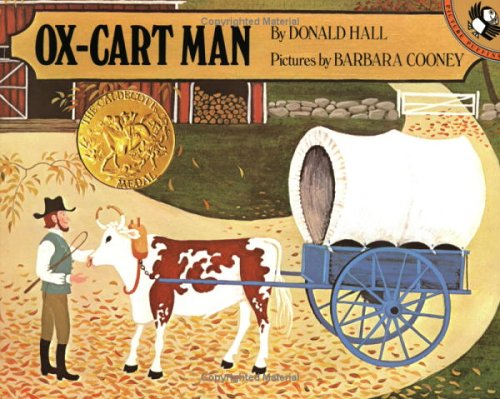
by Donald Hall, illustrated by Barbara Cooney
Caldecott Winner, 1980
If I had to pick a single favorite book, I think it might be this one. The illustrations are reminiscent of Grandma-Moses-y folk art, and they suit the story perfectly. The story follows one of my favorite themes for children's books: the work and produce of the seasons. It also speaks to my Yankee roots with its New Hampshire setting (rolling hills, little hamlets with tidy white churches) and message of hard work and thrift. Andy likes the woodworking, and I like the fiber craft. In fact, I don't think there's anything about this book I don't like. Ben likes pointing out the cheese in the shop and the lights in the window of the farm when the Ox-Cart Man returns home.

by Leo Lionni
I love a little postmodern meta: so sue me. This is a sweet little tale about rabbits. It's also a bit of a meditation on the construction of reality. The hardcover version we have (a gift from C. -- thanks, C.!), which I hope is the same one I've linked you to, is a tactile pleasure in itself, a small volume perfect for little hands and a novelty for adult ones. It's also very pretty. I'm not sure what Ben likes about this one, but he demands it regularly.
At the Top of My Voice
by Felice Holman, illustrated by Edward Gorey
This one's out of print, I'm afraid, but it's not hard to get a decent used copy from, oh, let's say Amazon. I grew up with this book, and it's in my blood the way lines of liturgy run in the veins of someone raised to church. On tiptoe I'm taller, and taller I'm older. And I'm not Nan, I'm a dancer. And City asleep, city asleep, a carnival on the garbage heap. The poems are great, and the illustrations are great, and little kids should grow up with good poetry so they learn to love it before they can learn to fear it. Ben likes the squirrel, the birds, and the lion.
Wednesday, April 7, 2010
Beating It*
I should probably leave well enough alone, but I went to bed last night still thinking about the anti-circ petition and what I'd said about it, unable to let it go, and convinced I'd become bogged down in nitpicking the text instead of making the bigger points that were really under my skin. (Ew, how did I end up with lice metaphors?)
So, allow me to beat this dead horse.
I don't think opposition to routine circumcision is wrong -- generally I find it reasonable and justified, and though I chose to circumcise my son, I consider myself an opponent of routine circumcision. But this petition obliterates any respect I might ever have had for the sense of anyone involved with it because it A) seeks to shut down debate rather than encourage it, and B) shows no respect whatsoever for science or expertise.
If you have taken a position based on a reasonable interpretation of factual evidence, you should never be afraid to hear new evidence that tests your position. If you're correct, new evidence will bear you out. If you're incorrect, why would you want to maintain your position? Similarly, you shouldn't be afraid to argue the point, especially with an expert in the field. Opposition to routine circumcision isn't an irrational position and has considerable foundation in medical science, so of all the responses available to a potential challenge, why on earth choose the one that boils down to SHUT UP SHUT UP SHUT UP LALALALALA WE CAN'T HEAR YOU?
I can't fathom what motive the authors and supporters of the petition ascribe to the CDC for doing something so unethical and counter to its mission as ignoring -- not insufficiently weighing, but ignoring -- the risks of a procedure it is considering recommending. The CDC is not some crazy bunch of penis-mutilating yahoos. It is a body of public health experts. Being human, of course, they are fallible and certainly have biases of their own. It is foolish to take their word as gospel, but it is equally foolish not to accord them the respect their expertise deserves. If we could all conduct research and draw appropriate conclusions, we wouldn't need scientists, but the fact is that we're all a little busy doing other things, and many of us plumb ain't smart enough, and few of us have the talent or training, honed over a lifetime, to conduct or interpret the kind of medical research that the CDC is reviewing before making its recommendations. Skepticism is fine -- it's admirable even -- but when it crosses the line into anti-intellectualism, into opposition to science itself, it deserves a smackdown.
Though I chose to circumcise my son, I do not support routine circumcision. But if the CDC is considering recommending it, I'm certainly interested to hear why. What research, what interpretation of the research, could support such a radical position? I look forward to the opportunity to re-evaluate my own position in light of new evidence or new argument. I look forward to hearing the opposition's response -- if it's rational, if it's based, as the CDC's certainly will be, on evidence and informed interpretation.
I definitely look forward to any chance to improve public health. If it turns out that the research demonstrates that routine circumcision actually does provide a significant protection against deadly STDs, against cancer, wouldn't that be good news?
*I'm so sorry. I'm 12, and I can't write two whole blog posts about penises without a single bad pun.
So, allow me to beat this dead horse.
I don't think opposition to routine circumcision is wrong -- generally I find it reasonable and justified, and though I chose to circumcise my son, I consider myself an opponent of routine circumcision. But this petition obliterates any respect I might ever have had for the sense of anyone involved with it because it A) seeks to shut down debate rather than encourage it, and B) shows no respect whatsoever for science or expertise.
If you have taken a position based on a reasonable interpretation of factual evidence, you should never be afraid to hear new evidence that tests your position. If you're correct, new evidence will bear you out. If you're incorrect, why would you want to maintain your position? Similarly, you shouldn't be afraid to argue the point, especially with an expert in the field. Opposition to routine circumcision isn't an irrational position and has considerable foundation in medical science, so of all the responses available to a potential challenge, why on earth choose the one that boils down to SHUT UP SHUT UP SHUT UP LALALALALA WE CAN'T HEAR YOU?
I can't fathom what motive the authors and supporters of the petition ascribe to the CDC for doing something so unethical and counter to its mission as ignoring -- not insufficiently weighing, but ignoring -- the risks of a procedure it is considering recommending. The CDC is not some crazy bunch of penis-mutilating yahoos. It is a body of public health experts. Being human, of course, they are fallible and certainly have biases of their own. It is foolish to take their word as gospel, but it is equally foolish not to accord them the respect their expertise deserves. If we could all conduct research and draw appropriate conclusions, we wouldn't need scientists, but the fact is that we're all a little busy doing other things, and many of us plumb ain't smart enough, and few of us have the talent or training, honed over a lifetime, to conduct or interpret the kind of medical research that the CDC is reviewing before making its recommendations. Skepticism is fine -- it's admirable even -- but when it crosses the line into anti-intellectualism, into opposition to science itself, it deserves a smackdown.
Though I chose to circumcise my son, I do not support routine circumcision. But if the CDC is considering recommending it, I'm certainly interested to hear why. What research, what interpretation of the research, could support such a radical position? I look forward to the opportunity to re-evaluate my own position in light of new evidence or new argument. I look forward to hearing the opposition's response -- if it's rational, if it's based, as the CDC's certainly will be, on evidence and informed interpretation.
I definitely look forward to any chance to improve public health. If it turns out that the research demonstrates that routine circumcision actually does provide a significant protection against deadly STDs, against cancer, wouldn't that be good news?
*I'm so sorry. I'm 12, and I can't write two whole blog posts about penises without a single bad pun.
Tuesday, April 6, 2010
Recommendations
Mothering magazine and Intact America (a non-profit advocacy group opposing circumcision) are calling for signatures on a petition to stop the Centers for Disease Control (CDC) recommending routine infant male circumcision.
Circumcision is not a big issue for me, though of course I'm aware that it's one of those parenting third rails, like breastfeeding and vaccination. I did a lot of reading about it before Ben was born, and the most I could muster was a mild bias against, based on a general principle of avoiding all non-crucial surgery. At the time, there was some not-extraordinarily-significant research supporting circumcision as plausibly prophylactic against certain STDs, and the combination of that, Andy's more-than-mild-but-not-very-strong bias for, and the extreme discomfort and embarrassment of a family friend who had to be circumcised for medical reasons in his 70s added up to a Yes. There's also in there somewhere, in a way I can't possibly justify, a weird little family-cultural / atheist-but-CYA adherence to the covenant. Or comfort in the tradition. Or notion of tribal belonging. Or something.
Anyway, like I said, it's not something I can work up a lot of strong feelings for or against, and it's one of those things, like whether you use a baby carrier or stroller, that I have a hard time understanding why some people are excited enough about to advocate publicly rather than simply decide for themselves. But I do feel strongly about this petition, strongly enough to have broken my own very sensible rule about not picking fights on Facebook.
Here's some of what Mothering says:
Mothering knows some stuff. Again, they don't cite references for how they know circumcision doesn't prevent transmission of STDs or how they know "there is NO link between infant circumcision and better health." And this kind of arrogant ignorance professing knowledge just honks me off. Take the claim that there's NO link between infant circumcision and "better" (as if that's even a meaningful or specific term) health: the American Medical Association says in this report, "there is little doubt that the uncircumcised infant is at higher risk for urinary tract infection." Smaller risk of UTIs = "better health"! But that's hardly the point, is it? The question isn't whether circumcision has any health benefits whatsoever (the most cursory review of current research makes it clear that it does); the question is whether the benefits are significant, whether they outweigh the risks and justify the costs. The ability to make that kind of essential distinction is only one of the reasons we trust the CDC before Mothering magazine to advise us about public health issues.
Mothering claims to want to convince the CDC to make the right decision. But to convince someone of something, you need to present an argument -- ideally with some evidence to back it up. A petition is not an argument. It's political pressure. It's a more or less polite way of ganging up. And I think we should all think very carefully about whether applying political pressure to the CDC is something we'd want to put our names to, or something we seriously think a group like the CDC should allow itself to be persuaded by.
It would be one thing if the petition advocated further specific study, if it made specific criticisms of the evidence, if it provided, in other words, an evidence-based argument to which it could then legitimately claim the CDC wasn't giving enough credence. But that's not what the petition advocates. Here's the text of the introduction:
Here's the text of the petition itself:
What I can't understand is, if they accept that the CDC is the foremost expert on public health in the US, that the CDC has a duty to present the truth to the American people, and that there is debatable evidence about whether routine circumcision is beneficial to the public health, why on earth they can't just get the hell out of the way and let the CDC examine the evidence and make its conclusions?
The evidence is debatable, so for pity's sake, let's debate it! Let's hear it, all of it, including what the CDC -- the acknowledged experts -- think we should do. Let's open our minds to the possibility that while there might not have been significant evidence to support recommending routine circumcision five years ago, or last year, perhaps there is now. And if there isn't this year, perhaps there will be five years from now. Let's keep asking the questions whose answers might save or improve lives, and let's listen to the people who can speak about those questions with informed intelligence before we start arguing with them. Let's not dig so deep into the trenches we make of our personal decisions that we can't occasionally climb out and take a look at what a new day's sun might have revealed.
Circumcision is not a big issue for me, though of course I'm aware that it's one of those parenting third rails, like breastfeeding and vaccination. I did a lot of reading about it before Ben was born, and the most I could muster was a mild bias against, based on a general principle of avoiding all non-crucial surgery. At the time, there was some not-extraordinarily-significant research supporting circumcision as plausibly prophylactic against certain STDs, and the combination of that, Andy's more-than-mild-but-not-very-strong bias for, and the extreme discomfort and embarrassment of a family friend who had to be circumcised for medical reasons in his 70s added up to a Yes. There's also in there somewhere, in a way I can't possibly justify, a weird little family-cultural / atheist-but-CYA adherence to the covenant. Or comfort in the tradition. Or notion of tribal belonging. Or something.
Anyway, like I said, it's not something I can work up a lot of strong feelings for or against, and it's one of those things, like whether you use a baby carrier or stroller, that I have a hard time understanding why some people are excited enough about to advocate publicly rather than simply decide for themselves. But I do feel strongly about this petition, strongly enough to have broken my own very sensible rule about not picking fights on Facebook.
Here's some of what Mothering says:
Based on flawed studies that ignore the risks and ethical concerns of infant circumcision, the CDC may recommend this unnecessary surgery for our baby boys. We know that safe sexual practices and abstinence – not circumcision – prevent sexually transmitted diseases. And we know that there is NO link between infant circumcision and better health.Mothering doesn't specify which studies it considers flawed and what those flaws might be. Unlike the CDC, it doesn't cite references. The CDC's fact sheet on male circumcision contains a useful paragraph, helpfully titled "Risks Associated with Male Circumcision," which includes no fewer than eight cites to studies that explicitly did not ignore the risks of the procedure. Mothering doesn't state its ethical objections, but I'm guessing they have something to do with the fact that an infant can't consent. And that's not something to dismiss out of hand, but we make decisions for our children every day, and that kind of ethical hairsplitting simply can't weigh heavily against substantive evidence (should there prove to be any) that performing the procedure would be a significant benefit to public health.
We will be delivering our petitions to CDC headquarters in April with the hopes of convincing them to make the right decision.
Mothering knows some stuff. Again, they don't cite references for how they know circumcision doesn't prevent transmission of STDs or how they know "there is NO link between infant circumcision and better health." And this kind of arrogant ignorance professing knowledge just honks me off. Take the claim that there's NO link between infant circumcision and "better" (as if that's even a meaningful or specific term) health: the American Medical Association says in this report, "there is little doubt that the uncircumcised infant is at higher risk for urinary tract infection." Smaller risk of UTIs = "better health"! But that's hardly the point, is it? The question isn't whether circumcision has any health benefits whatsoever (the most cursory review of current research makes it clear that it does); the question is whether the benefits are significant, whether they outweigh the risks and justify the costs. The ability to make that kind of essential distinction is only one of the reasons we trust the CDC before Mothering magazine to advise us about public health issues.
Mothering claims to want to convince the CDC to make the right decision. But to convince someone of something, you need to present an argument -- ideally with some evidence to back it up. A petition is not an argument. It's political pressure. It's a more or less polite way of ganging up. And I think we should all think very carefully about whether applying political pressure to the CDC is something we'd want to put our names to, or something we seriously think a group like the CDC should allow itself to be persuaded by.
It would be one thing if the petition advocated further specific study, if it made specific criticisms of the evidence, if it provided, in other words, an evidence-based argument to which it could then legitimately claim the CDC wasn't giving enough credence. But that's not what the petition advocates. Here's the text of the introduction:
No medical society in the world recommends male circumcision – yet newborn male circumcision is the most common surgical procedure in the U.S. This painful and risky procedure deprives more than a million boys each year of healthy, functional tissue – without their consent – while increasing medical costs by an average of $678 per baby.
The Centers for Disease Control (CDC) is developing public health recommendations for the U.S. on male circumcision that could ignore the serious risks of this non-therapeutic surgery. As the foremost expert on public health in our country, the CDC has a responsibility to share the truth about infant circumcision.
We need just a few more signatures to help us reach our 25,000 goal before the end of March. Sign our petition to the CDC below and demand a truthful statement on the risks and harms of newborn male circumcision.
So, if the CDC's recommendations don't ignore the risks of the procedure and do present a truthful assessment of said risks, but conclude that the benefits outweigh the risks, Intact America will support the recommendations?
Here's the text of the petition itself:
As the foremost expert on public health in our country, the Centers for Disease Control (CDC) has a responsibility to share the truth about public health issues that can affect millions of Americans.
Newborn male circumcision is the most common surgical procedure in the U.S. - yet this painful and unnecessary surgery carries serious risks, including hemorrhage, infection, surgical mishap, and death.
The role of circumcision in preventing sexually transmitted diseases (STDs) and other health claims has been investigated by public health researchers and remains highly debatable. Only safe sexual practices, such as the use of condoms and abstinence, can prevent STDs, including HIV/AIDS. Circumcision cannot be responsibly recommended as a way of preventing disease.
If the CDC chooses to promote newborn male circumcision, it is supporting a procedure called "non-therapeutic" by the American Medical Association - in favor of inconclusive and highly debatable research.Though Intact America makes no wild claims about what they know about circumcision, they throw the word "debatable" around as if it means "worthless." But they fail to mention what standard of proof they would find conclusive, and indeed fail to cite a single reference, most notably for their claims of the associated risks. They demand that the CDC admit the truth, implying of course that the CDC has failed to do so or is likely to fail to do so, but there is no evidence presented that suggests any kind of obfuscation or dishonesty.
I ask that the CDC not recommend circumcision as a means of preventing HIV/AIDS and formally recognize the risks and harms of the procedure and the right of every child to bodily integrity.
What I can't understand is, if they accept that the CDC is the foremost expert on public health in the US, that the CDC has a duty to present the truth to the American people, and that there is debatable evidence about whether routine circumcision is beneficial to the public health, why on earth they can't just get the hell out of the way and let the CDC examine the evidence and make its conclusions?
The evidence is debatable, so for pity's sake, let's debate it! Let's hear it, all of it, including what the CDC -- the acknowledged experts -- think we should do. Let's open our minds to the possibility that while there might not have been significant evidence to support recommending routine circumcision five years ago, or last year, perhaps there is now. And if there isn't this year, perhaps there will be five years from now. Let's keep asking the questions whose answers might save or improve lives, and let's listen to the people who can speak about those questions with informed intelligence before we start arguing with them. Let's not dig so deep into the trenches we make of our personal decisions that we can't occasionally climb out and take a look at what a new day's sun might have revealed.
Wednesday, March 31, 2010
Miscarriage
About a month ago, I got two lines on the pee stick. For the second time, it seemed, I got pregnant the first cycle of trying.
Yesterday I went for the dating ultrasound and discovered I had what's called a blighted ovum, which means the fetal pole (thus the embryo itself) never developed: I had a fetal sac and a yolk, but no fetus.
It's too soon to know exactly how I feel about this. I mean: I feel what I feel now, but who knows what I'll feel about it next week or next month or next year. Mostly, at this point, I'm surprised by how not surprised I am. On some level, I knew it. I had a bad feeling about this pregnancy, and some part of me is relieved to know for sure that it went wrong, to be able to move on rather than continue to worry about it. Of course, if the ultrasound had showed a squirmy little proto-human with a solid heartbeat, I probably would have shaken off the bad feeling and chalked it up to second-time-around jitters. You don't tend to know a lot about what can go wrong your first time. But then the second time, you know more mothers, and you've heard more stories.
I find myself comforted by the fact that an embryo never developed. There's something less tragic about a lost possibility than a heart that stopped beating.
It drives me crazy that there's no way to phrase it that doesn't lay the blame, at least grammatically, on me. I miscarried, or I had a miscarriage, or I lost the pregnancy. There's no the pregnancy failed, or the embryo lost itself. Even the word "miscarriage" tells you it was the carrier who fucked it up. English language FAIL.
I find myself dwelling on some really stupid details. Like: hey, now I can clean out the room where the cat boxes are so Andy doesn't have to do it. (Andy hates the cats, and I forgot to set him up with a minimally gross set-up to take over catbox tending while I was pregnant -- pregnant women aren't supposed to mess with kitty litter because of the risk of toxoplasmosis.) Like: crap, now if I get pregnant again ASAP, I'll end up delivering and racking up hospital bills on next year's deductible instead of this year's.
B., my nurse practitioner, said in terms of my health and well-being and future ability to conceive, it's about six of one, half dozen the other between letting nature take its course and having a D&C. In both cases, the risk of infection is around 7-9%. Which surprised me: that's a pretty high risk for a thing that happens so frequently. And this kind of infection can be extremely dangerous. The temptation to do the surgery is to have it all over with sooner and to skip the worst of the gore, though even with a D&C, you still have some bleeding and cramping. For now, though, I'm planning to let things just happen, with an option, of course, to go for the surgery if it's not happening fast enough or if it's too unpleasant. There's a considerable gross-out factor to the mechanics of miscarriage. B. said that because there's no fetus, for me it's likely to be more like a very heavy period. Let's hope so.
People who mean to be sympathetic and kind tend to say things about how nature gets rid of its mistakes or something, how miscarriage happens because the fetus wasn't good enough. I understand this impulse, and I certainly appreciate that it's kindly meant. But it's pretty stupid, and I wish people would think it through. Would you say that to someone mourning a person who died from a genetic disease? That it's somehow less sad because the person obviously wasn't made very well? Yes, it's true that many miscarriages are caused by genetic abnormalities. But that's not particularly comforting, especially because with current technology, some would-be mothers may actually know for a fact that that's not what caused their loss. They may have very strong, very complicated feelings about what did cause their loss, whether it's genetic abnormalities or something else. Plus, honestly, what seems comforting to one person may seem like minimizing to someone else, like: you shouldn't be so upset, because here's this information. In my opinion, the thing to say is the same thing you'd say to someone mourning any other loss: "I'm so sorry. Is there anything I can do?"
I cried on the table at the ultrasound. I cried in B.'s office. I cried in the car. I've cried a little here and there since. But mostly, so far, I'm ok. I know that I have physical discomfort and unsettling gore to look forward to, plus the hormone crash at the end. But for me, mostly, this feels like a very annoying roadblock between us and the next wonderful member of our family.
(One quick request: I'm going to link this post at Facebook, but I'd really prefer that people not comment about my miscarriage on my Facebook page. Comments here are fine, or feel free to contact me some other way.)
Yesterday I went for the dating ultrasound and discovered I had what's called a blighted ovum, which means the fetal pole (thus the embryo itself) never developed: I had a fetal sac and a yolk, but no fetus.
It's too soon to know exactly how I feel about this. I mean: I feel what I feel now, but who knows what I'll feel about it next week or next month or next year. Mostly, at this point, I'm surprised by how not surprised I am. On some level, I knew it. I had a bad feeling about this pregnancy, and some part of me is relieved to know for sure that it went wrong, to be able to move on rather than continue to worry about it. Of course, if the ultrasound had showed a squirmy little proto-human with a solid heartbeat, I probably would have shaken off the bad feeling and chalked it up to second-time-around jitters. You don't tend to know a lot about what can go wrong your first time. But then the second time, you know more mothers, and you've heard more stories.
I find myself comforted by the fact that an embryo never developed. There's something less tragic about a lost possibility than a heart that stopped beating.
It drives me crazy that there's no way to phrase it that doesn't lay the blame, at least grammatically, on me. I miscarried, or I had a miscarriage, or I lost the pregnancy. There's no the pregnancy failed, or the embryo lost itself. Even the word "miscarriage" tells you it was the carrier who fucked it up. English language FAIL.
I find myself dwelling on some really stupid details. Like: hey, now I can clean out the room where the cat boxes are so Andy doesn't have to do it. (Andy hates the cats, and I forgot to set him up with a minimally gross set-up to take over catbox tending while I was pregnant -- pregnant women aren't supposed to mess with kitty litter because of the risk of toxoplasmosis.) Like: crap, now if I get pregnant again ASAP, I'll end up delivering and racking up hospital bills on next year's deductible instead of this year's.
B., my nurse practitioner, said in terms of my health and well-being and future ability to conceive, it's about six of one, half dozen the other between letting nature take its course and having a D&C. In both cases, the risk of infection is around 7-9%. Which surprised me: that's a pretty high risk for a thing that happens so frequently. And this kind of infection can be extremely dangerous. The temptation to do the surgery is to have it all over with sooner and to skip the worst of the gore, though even with a D&C, you still have some bleeding and cramping. For now, though, I'm planning to let things just happen, with an option, of course, to go for the surgery if it's not happening fast enough or if it's too unpleasant. There's a considerable gross-out factor to the mechanics of miscarriage. B. said that because there's no fetus, for me it's likely to be more like a very heavy period. Let's hope so.
People who mean to be sympathetic and kind tend to say things about how nature gets rid of its mistakes or something, how miscarriage happens because the fetus wasn't good enough. I understand this impulse, and I certainly appreciate that it's kindly meant. But it's pretty stupid, and I wish people would think it through. Would you say that to someone mourning a person who died from a genetic disease? That it's somehow less sad because the person obviously wasn't made very well? Yes, it's true that many miscarriages are caused by genetic abnormalities. But that's not particularly comforting, especially because with current technology, some would-be mothers may actually know for a fact that that's not what caused their loss. They may have very strong, very complicated feelings about what did cause their loss, whether it's genetic abnormalities or something else. Plus, honestly, what seems comforting to one person may seem like minimizing to someone else, like: you shouldn't be so upset, because here's this information. In my opinion, the thing to say is the same thing you'd say to someone mourning any other loss: "I'm so sorry. Is there anything I can do?"
I cried on the table at the ultrasound. I cried in B.'s office. I cried in the car. I've cried a little here and there since. But mostly, so far, I'm ok. I know that I have physical discomfort and unsettling gore to look forward to, plus the hormone crash at the end. But for me, mostly, this feels like a very annoying roadblock between us and the next wonderful member of our family.
(One quick request: I'm going to link this post at Facebook, but I'd really prefer that people not comment about my miscarriage on my Facebook page. Comments here are fine, or feel free to contact me some other way.)
Subscribe to:
Posts (Atom)