Showing posts with label books. Show all posts

Friday, January 21, 2011

Seven Books We Like a Lot

I admit it: I don't like Dr. Seuss.  Partly it's a matter of unsuitability to Ben's age: the books are really aimed at children just learning to read, and the repetitiveness that makes them accessible to beginning readers makes them extremely tedious to me.  And they're way too long.  I could take 20 or even 30 pages of in a box or with a fox, but 62 pages?  No way, man.  It's torture.  And the illustrations are hideous!  Sadly, many adults who haven't read aloud to children for thirty or forty years (mis-?)remember Dr. Seuss with fanatical fondness, so Ben gets a lot of his books as gifts.  I keep meaning to put them into storage until the kid is ready to sound them out on his own -- I can quite imagine considerable cuteness issuing therefrom, but until that time, I'd really rather not see them again.  But Ben does like them, and he likes sitting by himself and paging through them without involving me, and I'm not a total jerk, so I won't take them away.  I won't read them at bedtime, though.

Andy and I each read the kid a book before bedtime.  Ben gets to pick, but we exercise the veto: that one's too long, Dad doesn't like this one, Mom read that one five times already this week, etc.  He's generally very accepting of our prejudices, and we are generally amenable to reading books we dislike when he loves them.  He goes through phases of devotion and antipathy with various titles, but the following are long-standing favorites of his and ours, which means they have whatever mysterious qualities make them attractive to this particular two-and-a-half-year-old, plus they are attractively illustrated, quirky or funny or presenting of some unusual perspective, not patronizing or twee or saccharine, and mercifully brief.

InstructionsInstructions by Neil Gaiman, illustrated by Charles Vess

Typical Gaiman, mining myth and fairy tale and stringing together references in that slightly breathless voice that fools you into thinking he's deeper than he is.  I have a lot of affection for the man, but I also find him infuriating.  Anyway, his schtick works extremely well here, except for a few places where he gets tripped up in language that doesn't quite work, and the illustrations are marvelous.  Part of the fun is picking out all the characters and creatures in the backgrounds.  Ben, for instance, sees Tomtens everywhere.

The TomtenThe Tomten by Astrid Lindgren, illustrated by Harald Wiberg

My first notion of this book came from knitting: iconic knitting designer Elizabeth Zimmerman named one of her more famous children's sweaters after the gnomic protagonist.  I knit the sweater before I read the book.  Then friends gave us a copy, and it became a favorite.  It's a strange combination of unnerving and warm -- the benevolent little Tomten pads around the farm at night talking to and doing favors for the animals, and it's all very sweet, but he's also a little non-human creature creeping about at night, which can't help being a bit creepy.  It definitely has that timeless, northern European thing going for it: it could take place in pretty much any century including our own, and that seems to be an appealing element in children's books -- to me, at least.  As is, come to think of it, that combination of creepy and comforting.

Arrow to the Sun: A Pueblo Indian Tale (Picture Puffins)Arrow to the Sun: A Pueblo Indian Tale adapted and illustrated by Gerald McDermott

On the whole, I like Anansi the Spider better, but I've already blogged about it.  And Arrow to the Sun is good, too.  Especially the Kiva of bees, which is Ben's favorite part.  It's not too often you see accusations of bastardy in children's books, and it's refreshing!  Not at all inappropriate!  Seriously, though, the way McDermott handles the strangeness of the cultures he presents (as if there's nothing strange about them, matter-of-factly, without oohing or pointing or -- worst of all -- explaining) and the sophistication of some of the concepts is masterful and positively awe-inspiring when you compare his work to the kind of multi-culti, Here Comes Hanukkah! drivel you generally see.

My Little Round House
My Little Round House, illustrated by Bolormaa Baasansuren, adapted by Helen Mixter

Speaking of multi-culti.  Mongolia isn't exactly a popular getting-to-know-you culture for toddlers, but this book is just terrific.  I can't express how gorgeous the illustrations are.  I know jack about Mongolian art, but the drawings manage to seem both entirely of their culture and yet thoroughly accessible to little kids, full of detail and yet not too literal.  The story is a bit shoehorned: the protagonist, born in spring, is crawling by summer and running at one year so that the tale fits into the one-year seasonal cycle, but I can suspend my disbelief on that one because the book is otherwise so charming.  ("Ger" rhymes with "bear," by the way.  Which I know because Andy corrected me.  He's been to Mongolia.  Show off.)

Angus and the DucksAngus and the Ducks, Angus and the Cat, and Angus Lost, written and illustrated by Marjorie Flack

No dog person could doubt for a moment that Angus was Marjorie Flack's actual dog.  He's as real a dog as I have ever seen presented in literature.  Possibly people who are not dog people will therefore find the appeal of these books limited, but I am bowled over again and again by their charm.  Part of the magic, too, is nostalgia for the kind of genteel, early twentieth century country life sketched in the margins: the milkman's horse, the chintz chairs, the tea service.  But it's mostly happy, dopey, having-of-dog-logic Angus and the scrapes he gets into and out of that make me smile whenever Ben pulls one of these books off the shelf.

Friday, April 9, 2010

Shillin' Like a Villain

Heaven help me, I signed up to be an Amazon Associate.  With my shall-we-say-modest readership, I don't expect to start sleeping on piles of cash anytime soon, but what the heck?  I pepper my posts with Amazon links anyway, so I might as well have a shot at getting paid for it.

So.  Here are some of Ben's and Andy's and my favorite picture books:

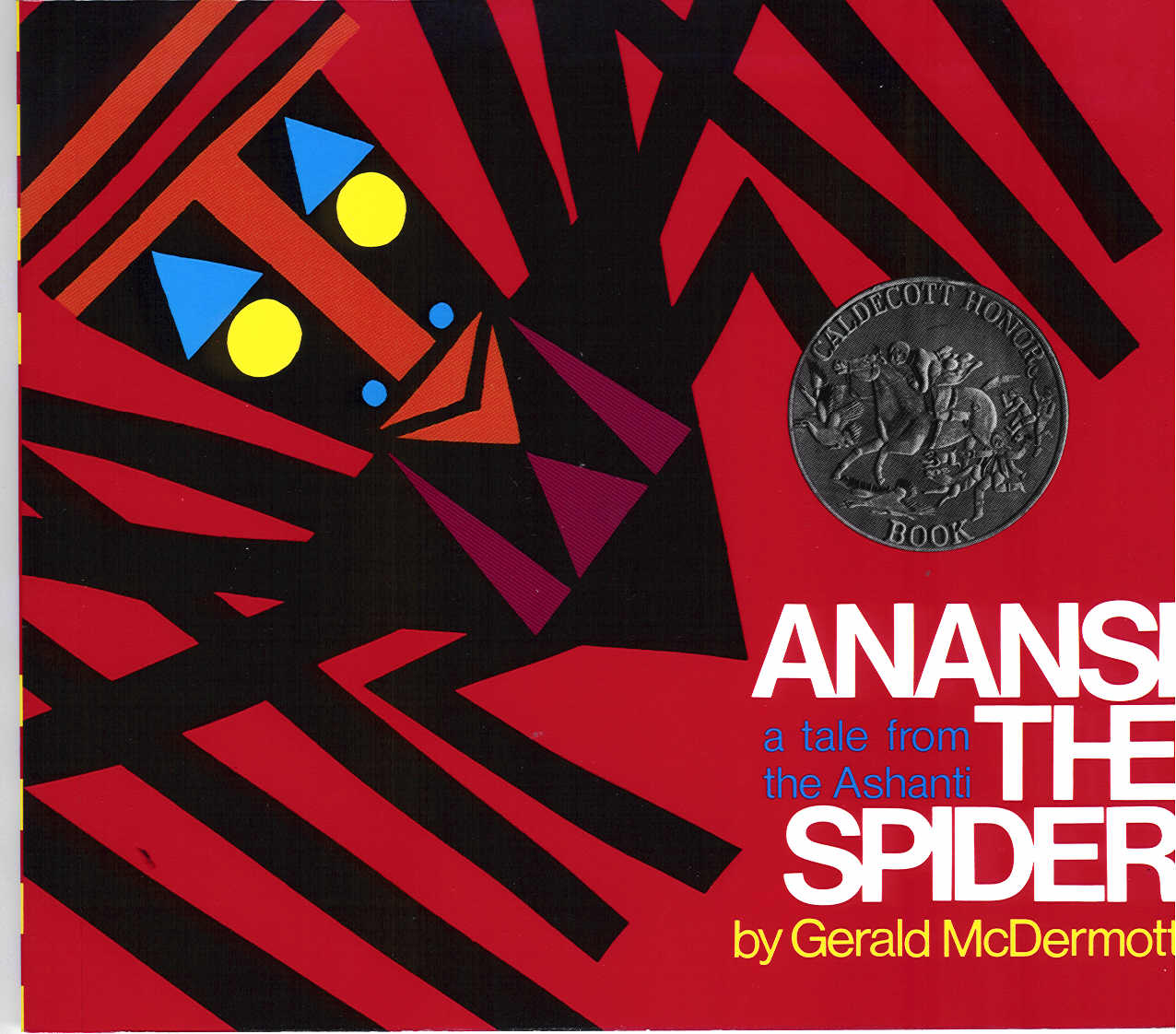
Anansi the Spider: A Tale from the Ashanti
adapted and illustrated by Gerald McDermott
Caldecott Honor, 1973

The illustrations in this book will cause you physical discomfort if you have astigmatism.  Seriously.  But that shouldn't stop you, bcause it is a goofy, goofy tale told in a voice that's inordinate fun to read aloud.  Ben liked it immediately, and it's remained among his top most-requested.  It took Andy and me a longer time to warm up to it, but it's earned a firm place in the household canon. 


All the World
by Liz Garton Scanlon, illustrated by Marla Frazee
Caldecott Honor, 2010

I'd be lying if I said the latte-liberal fantasy element of this book didn't make me a little queasy, though I'm about as latte liberal as it gets.  The farmers' market!  The happy plump lesbians on their tandem bike!  The baby in an Ergo!  All the World indeed -- if all the world were only such a quiet and carbon-neutral resort town!  Also, there's something facile about the lists of things with no active verbs -- they make for nice rhymes, but they don't go anywhere or do anything.  Still.  I can't actually read more than three pages without choking up, and the illustrations are so beautiful and intricate, the little town with its geography and genealogy fully imagined, each page referring to all the others.  My head thinks this book is very, very silly, but my heart loves it very, very much.  Ben likes all the dogs and trucks.

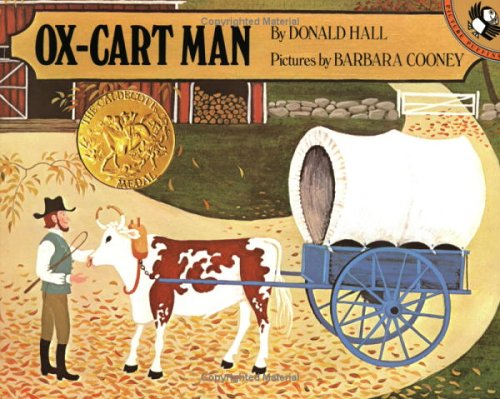
Ox-Cart Man
by Donald Hall, illustrated by Barbara Cooney
Caldecott Winner, 1980

If I had to pick a single favorite book, I think it might be this one.  The illustrations are reminiscent of Grandma-Moses-y folk art, and they suit the story perfectly.  The story follows one of my favorite themes for children's books: the work and produce of the seasons.  It also speaks to my Yankee roots with its New Hampshire setting (rolling hills, little hamlets with tidy white churches) and message of hard work and thrift.  Andy likes the woodworking, and I like the fiber craft.  In fact, I don't think there's anything about this book I don't like.  Ben likes pointing out the cheese in the shop and the lights in the window of the farm when the Ox-Cart Man returns home.

Let's Make Rabbits
by Leo Lionni

I love a little postmodern meta: so sue me.  This is a sweet little tale about rabbits.  It's also a bit of a meditation on the construction of reality.  The hardcover version we have (a gift from C. -- thanks, C.!), which I hope is the same one I've linked you to, is a tactile pleasure in itself, a small volume perfect for little hands and a novelty for adult ones.  It's also very pretty.  I'm not sure what Ben likes about this one, but he demands it regularly.


At the Top of My Voice
by Felice Holman, illustrated by Edward Gorey

This one's out of print, I'm afraid, but it's not hard to get a decent used copy from, oh, let's say Amazon.  I grew up with this book, and it's in my blood the way lines of liturgy run in the veins of someone raised to church.  On tiptoe I'm taller, and taller I'm older.  And I'm not Nan, I'm a dancer.  And City asleep, city asleep, a carnival on the garbage heap.  The poems are great, and the illustrations are great, and little kids should grow up with good poetry so they learn to love it before they can learn to fear it.  Ben likes the squirrel, the birds, and the lion.

Friday, January 29, 2010

Themes Cornball and Otherwise

I remember being offended, before I had a kid, at the idea that I couldn't possibly know what it was like to have a kid. I'd been a kid. I'd been in love. I'd had vulnerable and beloved creatures in my care. And I had powers of empathy and imagination. So, sure, I couldn't know exactly what it was like, but surely I could imagine something close enough that my opinion wasn't totally discountable, right? The thing is, now that I am a parent, I really can't remember what I thought it was going to be like, so I have no idea how close my imagination got. My sense is: not very.

For one thing, loving my child is simply not like any other love I've felt before. It's not just a different flavor; it's a totally different food. Sure, it has things in common with loving a spouse, loving a parent, loving a pet -- it's still love. But it's profoundly different. Nobody else's suffering or delight could come close to affecting me the way his does. He belongs to me and I belong to him in a way that's nothing like the connection I feel to other people I love. (And that's not to disparage my other relationships. I have good, close connections to the important people in my life.)

I'm also responsible for him in a way that's unlike any other relationship. It's a responsibility that's hardwired, that I actually feel physically. The sound of him crying out in genuine anguish (as opposed to frustration, discomfort, boredom, or any of the other smaller unhappinesses that are immediately distinguishable from real trouble) isn't just a sound; it's like a klaxon in my spinal cord. But it's not just that. It's always being aware of him, even if we're not in the same town, even if I'm not actively thinking about him. It's like I have radar in the back of my mind, and the little blip that's Ben is always there, blinking.

Being a parent also connects me to the world in a new way, and more profoundly. Partly it's just having a bigger stake, I think, though you'd have thought being alive was a pretty big stake to start with. But it's really not -- not compared to being responsible for a small and completely precious person. For one thing, I don't think it would even have occurred to me to consider what my stake in the world was before I had a kid. So it's that, and it's sharing a deeply meaningful experience with the majority of humanity. In a very real way, I have something in common with parents in Khartoum, in Osaka, in Helsinki. For that matter, I have something in common with leopard mothers and chickadee mothers and coyote mothers. And I'm not talking about some goofball intellectual exercise; this is something I feel pretty deeply, something that's changed the way I exist in the world. And there's something else, harder to define: when it comes to passage-of-life stuff, there's a sweet in the sad and a sad in the sweet that I never felt before. German probably has a word for this mournful joy, but I don't. It's a bit like stepping back so far to see the forest that suddenly you see that joy and mourning are part of the same thing, a connectedness, an investment in the world, an expression of love.

It's tough to talk about any of this without sounding pretty colossally cornball. But I find that I don't care all that much about whether I sound cornball. And I really have no idea whether other parents feel the same way. I imagine there are as many different ways to experience parenthood as there are ways to experience romantic love, if not more. But we all hear about romantic love all the time. It's in every song, in every book, in every movie. People talk about falling in love and falling out of love, and we all have lots of words to describe the stages and problems and joys and minutiae of romantic love. And yes, we talk about parenting, one parent to another, and there are books of advice and instruction, and God knows there are blogs. But it's not the same.

My friend C., the domestic theologian, was looking for examples of literature about motherhood. Can you think of any? It's difficult to think of examples of mother characters, let alone examples where the mother is the protagonist and motherhood is a dominant theme. Kristin Lavransdatter was pretty much the only real example anyone could come up with. For a profound human experience, that's a pretty big gap in the market. I think talking about the big-picture, major-theme stuff of parenthood feels corny because it's been more or less exclusively the province of greeting cards and inspirational wall-hangings. Which I just so fundamentally don't understand. I look to literature to help explain my world, and it's like I just fell in love for the first time, and no one had ever written a book or made a movie about romantic love. And worse than that: that the very idea of taking romantic love seriously as a literary theme was kind of laughable and embarrassing.

So, a couple of things. First, everybody should immediately read Kristin Lavransdatter, which is a great (and I mean Great in the sense of Major Work of World Literature, as well as great in the sense of really wonderful) book, apart from being the only book I've ever read in which the protagonist's breast-feeding matters to the story. Second, and I mean this seriously: What the fuck? Why isn't there a canon of literature on the theme of parenthood to match the theme of romantic love? Is it as simple and stupid as the lack of female authors? And the fact that until pretty recently, women who wrote books tended to be women who didn't have children? I can sort of accept that explanation, except that fatherhood is pretty profound, too, so where are the themes of fatherhood in our glorious literature of the patriarchy?

It's a head-scratcher.

Monday, November 2, 2009

Snapshots

Still no words. But when you ask him, "Hey Ben, when are you going to learn to talk?" he puts on this sweet, half-whispery voice and says, "Da da da da da da da," like: I got yer talking right here, silly adult.

He's been climbing up stairs for months now, but he wasn't going down them, and I was getting tired of schlepping thirty pounds of him every time he needed a diaper change, so we did a little crash course (without any actual crashes, thank goodness) in knees-and-belly descent last week, and now he goes down faster than he goes up.

He went trick-or-treating for the first time this Halloween, which meant I went trick-or-treating for the first time in more than 20 years. He was kind of perplexed by the entire ordeal, but totally game, and he definitely approved of the candy part. His enthusiasm was underlined by the howling and grabby-pointing after the pumpkin bucket when I disappeared it.

He very much enjoys watching the Life of Mammals dvds and slideshows of various animal groups on Flickr, especially Wild Animals in Action, both of which I heartily recommend for toddler-adult entertainment. He likes to point out each and every critter and say "Dah!"

He's all about cars and trucks lately, and in fact just walked in here with a toy car in each hand and then took them both over to the stairs to push them around. Walking through a parking lot can include his pointing at every single car we pass and saying, "Dah!"

He is a huge fan of books, and would probably be content to do nothing but bring me one book after another to read until we ran out of books, and then he'd want to start over at the beginning. Granted, I'm not that familiar with other toddlers' reading habits, but he seems remarkably patient with wordy books (like, say, Ping or Ferdinand) and also remarkably gentle with paper (i.e., not board) books. He will often amuse himself for long periods of time just sitting on the floor and paging through books, sometimes da-da-da-ing to himself.

He recently learned how to dip french fries in ketchup, and now he dips whatever into whatever else at every opportunity.

Monday, June 22, 2009

Unsolicited Advice: Crack a Book!

People are funny about parenting books. Even among people I'd generally consider fairly book-friendly if not book-obsessed, there's often an attitude of disdain and dismissiveness about taking parenting advice from a book. Of course, the disdain appears most prominently when the book advice disagrees with the disdainer's. But even when it's not a case of competing expertise, there's a common sense that parenting is just isn't the sort of thing that experts can help with.

And I understand and even to some extent even agree. Parenting books can only talk in generalizations and averages, and when your child lies outside the catchment of the generalization, the advice isn't much use, and can be demoralizing. I remember reading (it was Ferber or Weissbluth, I can't remember which) that there's no such thing as a kid who's just naturally a bad sleeper -- there are only kids who haven't been shown how to sleep well. Which I read, not surprisingly, as a blistering indictment of my parenting. Not helpful. And now that I have more confidence as a parent, I can say with assurance that that's nonsense, that while I'm sure any baby's sleep can be improved in various ways, there absolutely are sleep-resistant kids, and mine is absolutely one of them. So I support taking expert advice with a grain of salt, and I certainly support skepticism of any advice that undermines you or seems not to jibe at all with your own observation.

But.

What I don't understand and can't support is not reading the books at all. I can't count the number of times a parenting book introduced me to a concept that had never crossed my mind, or offered a tactic or solution or small but crucial course correction that I found helpful. Even just reinforced something I'd done at first instinctively, or backed up a decision I made thoughtfully but absent expertise.

I think we sometimes have this notion that parenting ought to come naturally. And to some extent, it does. I'm pleasantly surprised by the number of times I've done something without thinking it through, without making a conscious decision about it, and had it turn out very well, turn out in some cases to be exactly the thing the experts say you should do. But just because it's possible, even common, to stumble blindly into doing the right thing doesn't mean we shouldn't be aiming for conscious and conscientious parenting. I've observed too many parents whose instincts are flat-out crappy to have any real faith in instinct. And though I often get great advice and the benefit of other people's experience by talking to friends, there's no way for casual conversation to cover parenting topics as broadly or thoroughly as a book can.

Or, more accurately, as a whole bookshelf can. Because you can't just read one book, or a few books. Because the experts disagree, and you may disagree with the experts. If you only read Dr. Sears because you're all about AP, there's a lot of helpful information you'll never get, a lot of dissenting opinions that may suprise you by ringing true. Sometimes the books that challenge your cherished notions of parenting are the most helpful because they're the ones that make you think hardest about why you make the decisions you do.

Tuesday, May 12, 2009

Dogs! Dogs! Dogs!

Ben has enjoyed paging through his big photo books (especially this one and this one) for a while now, but it's mostly been clear that his pleasure has had more to do with the hinge-motion of the pages than observing the pictures. But recently he's made the mental leap and is able to recognize that the images correspond to real-world objects and creatures.

At least, if they're dogs.

We have two basset hounds, Lola and Hugo, and as I mentioned here, I first noticed he'd acquired some receptive language when I named the dogs and he looked at them. He likes them both very much, and the feelings are decidedly mutual. So it's no surprise that they continue to open developmental doors for him.

This latest started with the basset hound calendar in the kitchen, which was the first image Ben got excited about, first grinning and then pointing and grinning, wanting to be taken closer so that he could smack at the image, possibly making sure there wasn't really a doggy behind it somewhere. Then he and I were paging through one of his picture books, and he pointed at a photo of a dog: "Dah!" This dog wasn't a basset hound. And then he pointed at a bear and a wolf and a cougar. So, ok, we haven't exactly narrowed down what a dog is, but bears and cougars aren't that far off, and wolves are just dogs whose ancestors -- rather shortsightedly -- resisted the appeal of human garbage heaps. Which of course makes me think about how I know a wolf from a bear from a dog, how infinitely complicated those distinctions are, what a miracle it is that my not-quite-year-old can do it, how essential this kind of detailed visual sorting must be to human evolutionary success.

And then the thing that really knocked me out: he pointed out the doggy in an illustrated book. And not a photorealistic illustration, rather a stylized one (in Dav Pilkey's The Paperboy). This dog isn't a basset hound, either, but it is a low-rider and a bit of a fatty, so similar. Still, how does the kid know? What markers of dogness do his real dogs share with this painting? In the time before photography, did it take longer for babies to recognize images? Do photographs create a kind of visual bridge between the real and the imagined?

When her first child was around Ben's age, my friend C. asked me for photos of Lola, who was a puppy at the time. (I believe I sent her prints -- decent images were probably too big to email eight years ago, and there was no such thing as Flickr.) She was making a doggy picture book for her son. I loved the idea, and loved that she wanted to include Lola. Last week, I made one for Ben, with photos of our dogs, dogs we know, and lots of dogs from the Dogs! Dogs! Dogs! pool at Flickr. (Scotch photo laminating sheets are awesome.)

He loves it.

Friday, January 16, 2009

The Crap vs the Heirloomery

A silver porringer. A silver cup. A bright yellow sweater. Velour overalls. These are relics of my own babyhood that have an active place in Ben's.

I fed him baby cereal from the porringer at every meal for a while there, until the charm faded a bit when his menu expanded and created even more dishes and I didn't feel like hand-washing the bowl three times a day. The silver cup is in the box of toys next to his green chair in the kitchen. It gets pulled out and handled and chewed on many times every day. Every so often I put a splash of water in it and hold it to his lips, tip it back, and see what happens. When he's ready to use a cup, it will be his first.

The sweater is getting lots of use lately in the wicked cold snap we're having. My mother made it for me. I'm doing some knitting myself now for Ben, and I tend towards chunky yarn and big needles for fast knitting, but Mom's project was way more ambitious: it's minutely knit of fine wool, but sturdy, and it's held up marvelously and is as useful an object as it is nostalgic and charming. The overalls, too. Mom ordered them from Switzerland, which, back in the 70s with no Internet (and did they even have phones?), what a project! They're great stretchy, soft, super-sturdy little numbers, though, and they, too, are employed for use as much as memory.

There are some other objects, though, of which I've also taken custody, that don't translate into use. There's the fine cotton bib with delicate embroidery, which I'm sure I'd have to hand-wash, and which might not stand up to it. This is a relic of Mom's babyhood which was pressed into service again for mine. There's the little silver chain with two clips shaped like duckies; one is supposed to clip a washcloth and use it as a bib, and back in the days before Velcro, I'm sure it represented a convenience. Now it seems fiddly and precious and time-wasting.

There are things from Ben's babyhood I'll pack away, hoping he or a subsequent kid will someday provide me with grandchildren and want to use. The silver cup and porringer, certainly, and the clothes, providing they make it through my kids' use. Sweaters I'll knit myself, and well made baby clothes I've come to love. Maybe one or two of the nicer wood baby toys, to which I've grown unaccountably attached. But none of the useful objects of babyrearing: not the spoons or bowls or cups, not the bibs, not the chairs (though I'm thisclose to buying the kid a Svan). So many of these things of daily use are well made for their purposes, which means easy to sponge off or machine wash, or thoroughly disposable, and therefore in no way candidates for heirloomery. Which is fine. I'm enough of a packrat without falling in love with every bit of baby gear. And if I'm tempted to bewail our culture's sad tendency towards the plastic, the crappy, the disposable, I just think about the entire day every week my grandmothers had to devote to nothing but washing clothes, and how much cleaning a baby created back before all these crappy but convenient products, and I thank my lucky stars.

Sunday, November 23, 2008

Essential Bookshelf: Kid


These are some of the books I really enjoy reading to the youngster.

Caps for Sale
I like to do the salesman's lines in a broad Italian accent, and I also make all the gestures and shout when the salesman gets furious at the monkeys, which makes Ben twist himself around to look at me as if I've taken leave of my senses.

Hondo and Fabian
LinkThis is a gentle little story about a dog who goes to the beach and a cat who stays home. I can't quite put my finger on what I like so much about it, but I absolutely adore it.

Does a Kangaroo Have a Mother, Too?
Ah, the Eric Carle hegemony. I love books with lots of animals, and this one is a jackpot. Not only does it have lots of animal moms and babies, the last page gives the names for adult breeding pairs, offspring, and collective nouns for all the animals -- so cool. This is my favorite Eric Carle book.

Ten Little Fingers and Ten Little Toes
Generally I resist explicitly messagey children's books (as well as explicitly educational ones -- my infant doesn't need to learn to count or have the virtues of tooth-brushing extolled to him, thanks), but this one is so sweet that I don't care that it's about tolerance. Nine times out of ten, I'm a little choked up by the time I get to the end.

The Story of Ferdinand
Only some kind of humorless jackass could resist Ferdinand.

Friday, November 14, 2008

Essential Bookshelf

I keep meaning to grab the parenting books I like a lot and do reviews of each. And I'll get around to it eventually.

For the time being, though, I thought I'd just list 'em, and open up the floor to parent-readers to comment or list their own favorites.

Burton White, The New First Three Years of Life
American Academy of Pediatrics, Caring for your Baby and Young Child: Birth to Age 5
Penelope Leach, Your Baby and Child: From Birth to Age Five
Ellyn Satter, Child of Mine: Feeding with Love and Good Sense